


Cargo Lift vs. Person-Certified Lift: Choosing the Right Tool for the Job
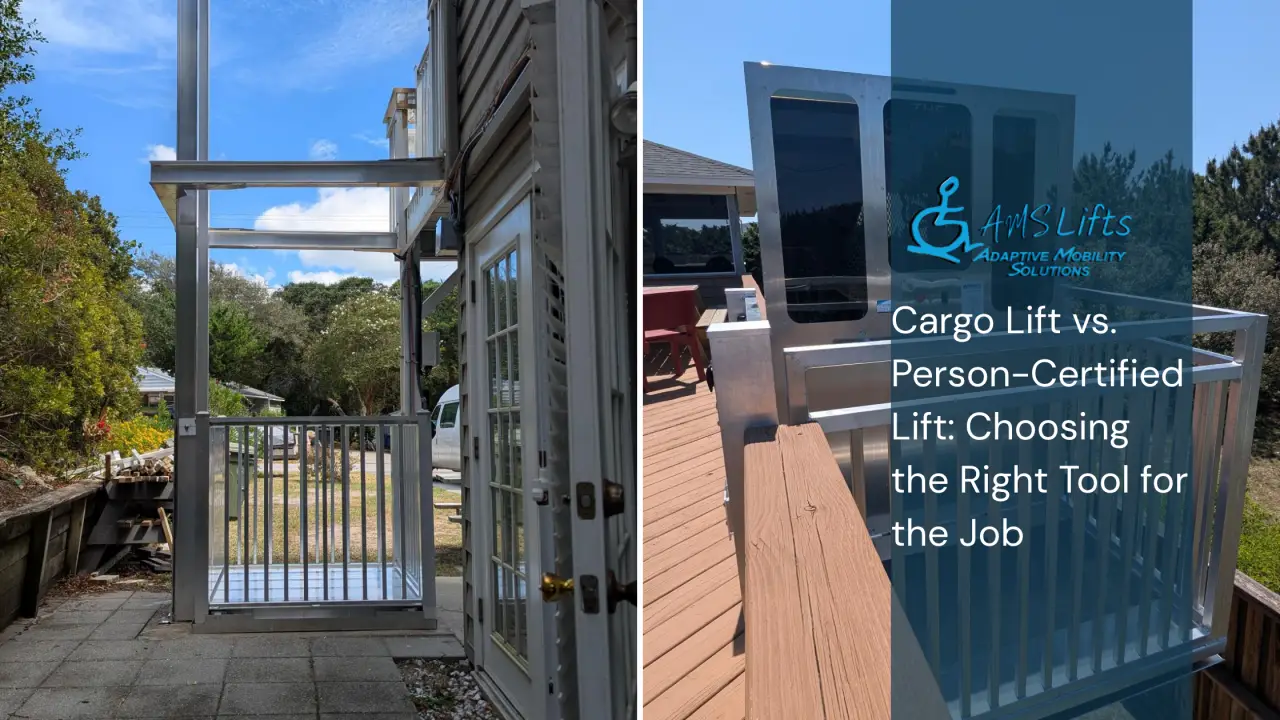
Table of Contents
When it comes to home accessibility solutions, using the right equipment matters.
There’s a reason a toolbox has more than one tool in it. You wouldn’t use a hammer to turn a screw, and you shouldn’t use a cargo lift to move people.
Homeowners across Eastern North Carolina, especially in coastal areas like Washington, Greenville, and the Outer Banks, often compare cargo lifts and wheelchair lifts when planning home accessibility upgrades.
If you’ve been searching for cargo lift vs residential elevator or wheelchair lift for home cost, you’ve probably seen a lot of mixed information
Here’s the straight answer:
They are not the same thing.
They are not interchangeable.
And picking the wrong one usually shows up later, when it’s more expensive to fix.
What Is a Cargo Lift Used For in Residential Homes?
A cargo lift is built for one purpose: moving items. That’s it.
Think of groceries, suitcases, coolers, and tools. Especially in coastal and elevated homes, where carrying items upstairs becomes a daily hassle, and nobody wants to make 10 trips up the stairs.
- Lower upfront cost
- No permitting in many cases
- No major deck or structural changes
- Simple install
Are Cargo Lifts Safe for People? (Important Limitations)
A cargo lift is not designed to carry people. No safety interlocks. No rider protection. No code compliance for human transport.
And yes, you can try to “upgrade” a cargo lift. Add gates. Add switches. Add layers of safety.
Here’s the problem:
- The cost climbs fast. Not a little. Exponentially.
- The system still isn’t fully code-compliant
- In many areas, it still won’t pass permitting
Some municipalities won’t even entertain it. Nags Head is a good example. If it’s intended for people, they want a proper person-certified lift. Not a modified workaround.
What Is a Person-Certified Lift? (VPL, Porch Lift & Residential Elevator Explained)
Now you’re in a different category. A vertical platform lift (VPL, porch lift, wheelchair lift) or residential elevator is built around one thing: safe human transport.
That changes everything.
What Makes a Wheelchair Lift or VPL Safe for Home Use?
- Interlocked gates that must be closed before movement
- Constant pressure controls that stop when released
- Safety sensors and obstruction detection
- Code compliance (ASME A18.1)
- Smooth, controlled operation
- Required permits and inspections.
Why Using a Cargo Lift for People Can Cost More Later
A lot of people try to make a cargo lift a home elevator alternative or a person lift alternative.
Usually, it comes down to cost.
It sounds reasonable at first:
- “We’ll just be careful.”
- “It’s basically the same thing.”
It’s not.
This decision often becomes a problem when:
- Selling the home
- A home inspection is required
- A renter or guest uses the lift
- An accident occurs
- At that point, the system may need to be replaced, removed, or explained, often at a higher cost.
Cargo Lift vs Wheelchair Lift: Which Adds More Home Value?
If you’re looking up home elevator costs or a wheelchair lift for home, you’re probably focused on the number.
But long-term value matters just as much.
Does a Wheelchair Lift Increase Home Value or Rental Income?
On resale:
- Expands your buyer pool
- Supports aging in place
- Demonstrates code-compliant improvements
For rental properties (especially for coastal home accessibility):
- Makes the property usable for more guests
- Reduces liability risk
- Can justify higher rental rates
In a lot of cases, the price difference between a cargo lift and a person lift gets absorbed on the back end, either in resale or rental income.
A cargo lift does not provide the same return.
When Is a Residential Cargo Lift the Right Choice for You?
Cargo lifts absolutely have a place.
They make sense when:
- You are only moving items
- No one will ever ride it
- You want a fast, lower-cost solution
- You are avoiding permitting and structural work
Used correctly, they are extremely useful.
Cargo Lift vs Person Lift: Which One Should You Choose?
This decision doesn’t have to be complicated:
- Moving groceries? → Cargo lift
- Moving people? → Person-certified lift
You can save money upfront by choosing the wrong solution…
Or you can make the right investment and avoid issues down the road.
Only one of those holds up over time. Making it a perfect aging-in-place home solution.
Schedule a free home accessibility consultation today and find the right wheelchair lift, porch lift, or cargo lift for your home in Eastern North Carolina.

Written by:
Kristen Tschida, Owner and CEO of Adaptive Mobility Solutions
FAQs
Can a cargo lift be used to carry people?
No. A cargo lift is not designed or approved for transporting people. These systems are built strictly for moving items like groceries, tools, and luggage. They do not include the required safety features or code compliance needed for human transport.
What is the difference between a cargo lift and a wheelchair lift (VPL, Porch Lift)?
A cargo lift is designed to move items, while a wheelchair lift (also called a vertical platform lift or porch lift) is specifically built to safely transport people. Wheelchair lifts include safety interlocks, controlled operation, and must meet code requirements for residential use.
Do cargo lifts require permits in North Carolina?
In many cases, cargo lifts may not require permits, but this depends on the local municipality. If there is any intention of transporting people, most areas in North Carolina require a permitted, code-compliant lift such as a vertical platform lift.
How much does a wheelchair lift cost for a home?
The cost of a wheelchair lift depends on factors like the height of travel, installation requirements, and home layout. While they typically cost more than cargo lifts, they provide the safety features, compliance, and long-term value needed for transporting people.
Is a cargo lift a good alternative to a home elevator?
A cargo lift can be a good solution for moving items, but it is not a replacement for a home elevator or wheelchair lift when people need to be transported. Choosing the right system depends on how the lift will be used.